
If you’re looking to buy an air fryer for a small family of two or three people, you’ve come to the right place. I’ve personally reviewed and cooked in dozens of air fryers over the last two years. In this article, you can find out the pros and cons of some of the bestselling air fryers for small families.
Before we dive in, two of the four air fryers featured here were gifted to me by the manufacturer, but I haven’t been paid or asked to make this content. I’ll flag up which ones were gifted when we get to them. So here are the highlights of my reviews of four bestselling 6L air fryers.
Table of Contents
1. Cosori Dual Blaze 6.4L Smart Air Fryer

Overview
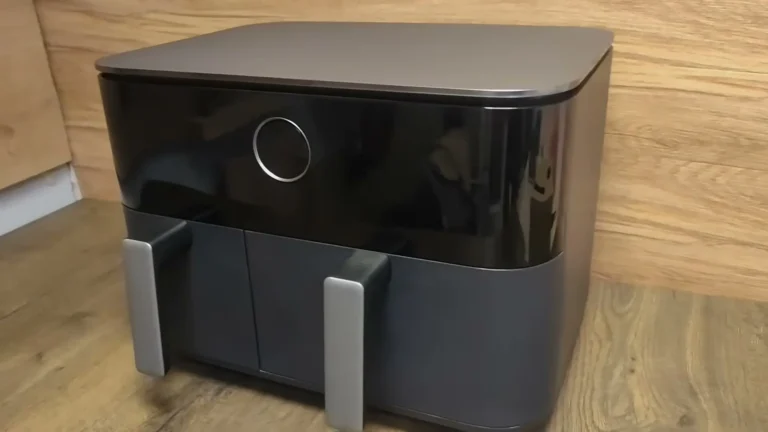
The Dual Blaze isn’t new. In fact, it’s been around since 2016. It’s a single drawer 6.4L smart air fryer, so it works with an app. But if that doesn’t appeal to you, you can also use it without ever having to connect it to Wi-Fi, just like a standard air fryer.
How to Set It Up as a Smart Air Fryer
If you want to use it as a smart air fryer, when you first get it, you’ll need to download the VSync app. Choose add a device and then press and hold the power button on your air fryer so it can connect to your phone.
Then in the app, you can choose from a range of recipes and set the air fryer up with the correct time and temperature direct from your phone. You can then keep an eye on the progress of your cooking in the app whilst you’re off doing something else somewhere else in the house.
Design and Build
The air inlet on this model is on the top at the rear and the outlet is on the back. There are also additional vents on the bottom of this air fryer because of that lower heating element. So the standard advice applies about pulling it out from the wall when you’re cooking.
The crisper plate on this has a slightly unusual design which I think makes it look like it’s permanently smiling at you. However, those big openings can be a little bit of a pain, as even quite large things like prawns can slip through the holes while you’re cooking and then you find yourself having to lift a hot crisper plate to try and retrieve them.
Cooking Functions
The Dual Blaze has 12 cooking functions. The six on the left of the display are for different types of food. The six on the right are for different cooking settings.
Starting on the right, the cooking settings use the top and bottom heating elements in slightly different ways. Air fry uses full power on top and on bottom. Reheat uses full power on top with low heat below. Roast uses medium power on top and full power on the bottom.
Keep warm uses medium heat above and below. Bake uses low power on top and full power on the bottom. Broil uses full power on the top and no heat below. This last setting is particularly recommended when cooking oily food to reduce smoke.
On the left hand side, you have those food specific presets, which are for particular types of food including chicken, steak, seafood, veggies, fries, and frozen. I did some research but I couldn’t find out which heating elements those food specific presets use. So if you want more control over where your heat is coming from, you’re probably better off sticking with the cooking settings on the right.
You may notice that there’s no dehydrate setting on the Dual Blaze, and that’s because the lowest temperature on this model is 80 Celsius. Its maximum temperature is 205 Celsius. You can alter the time and temperature while the program is running, and there’s a separate button for turning on and off and for starting the cooking program.
The basket and crisper plates are both non-stick and dishwasher safe. And as you would expect, cooking pauses automatically when you pull the drawer out and resumes when you put it back in.
Real Kitchen Testing: Does the Dual Heating Element Actually Make a Difference?
Obviously the thing I was most interested in finding out was whether that lower heating element actually makes any real difference in a real kitchen scenario when you’re cooking, given that the heat it produces can’t really circulate because it’s trapped by the drawer.
As well as cooking a variety of regular meals in it over the last couple of weeks, I also did three side by side tests with the Dual Blaze next to my Cosori Dual Basket.
The first test was chocolate cake. I made a batch of batter and then divided it exactly in half in two identical tins and cooked both cakes at 160 Celsius for 25 minutes on bake. The two finished cakes were pretty much identical, with the Dual Basket on the left and the Dual Blaze on the right. There was no difference in the rise or in the speed that they cooked.
Next, I wanted to try pastry to see if the bottom heating element made a noticeable difference to the bottom of a quiche. I made two identical spinach, feta, and tomato tarts. Both quiches were cooked at 160 Celsius for 25 minutes, the same as the cakes. The bottoms were just the same. The bottom heating element hadn’t made any difference to how well cooked the pastry was.
The final test was homemade fries. The Dual Blaze sells itself on being a no shake air fryer, so I wanted to test that out. I made two batches of chips, one in the Dual Blaze and one in the Dual Basket. I soaked them in cold water for 15 minutes to remove the starch and then cooked them on the fry setting in the Dual Blaze at 195 Celsius and on roast in the Dual Basket.
I started with five minutes with no oil just to dry them out, then added oil, and in the last five minutes I cranked up the temperature to 205 on both air fryers. The Dual Basket got a couple of shakes. The Dual Blaze did not.
The results were really interesting. There was a noticeable difference with the Dual Blaze, and the chips were definitely brown on the bottom despite the lack of shaking.
Final Verdict on the Dual Blaze
The Dual Blaze is a great air fryer, but remember it has been around for eight years. And what I find really interesting is that in all of that time, no other manufacturer that I’m aware of has copied the idea of putting two heating elements in an air fryer. If it were a brilliant idea, someone surely would have by now.
Clearly the Dual Blaze performs better with no shaking than other air fryers. So if you want a model where you can just stick the food in, control the cooking on an app, and walk away without having to change the temperature on the machine or shake the basket, then this is the air fryer for you.
But it’s important to say it’s also not a miracle worker. The difference with most dishes was barely noticeable. So if you’re looking at this as an upgrade, it probably isn’t worth trading in your existing air fryer just to get one with two heating elements over one.
2. Philips 2000 Series Air Fryer

Background and Technology
The one thing you may know about Philips when it comes to air fryers is that they lay claim to being the company that introduced the world to air fryers with their Rapid Air technology, which they developed with a Dutch inventor.
You can see evidence of that patented technology in the Starfish design on their air fryer logo and on the bottom of all their air fryer drawers. The swirling raised pattern is supposed to encourage air circulation and cook food faster, but it also has the downside of making it harder to cook directly in the drawer.
Philips are specifically marketing this 2000 series air fryer as having 13 functions, which they say includes stir fry and saute. The truth is that these air fryers with that raised pattern on the bottom of the drawer simply aren’t as suitable for that kind of cooking as models with flat bottoms.
Presets and Cooking Modes
Aside from the saute and stir fry functions on the control panel, there are eight different presets which cover frozen fries, homemade fries, drumsticks, meat chops, an oddly specific function called breakfast which is for cooking three eggs and two pieces of toast, muffins, fish fillets, and vegetables.
As far as I can ascertain, there is no variation in fan speed between these presets. So they are purely pre-programmed times and temperatures. The maximum temperature on this model is 200 Celsius and the minimum is 60 Celsius, which is right at the top end of the range for dehydrating, making this model less than ideal for one of the 13 cooking functions that Philips say it has.
Build Quality and Additional Features
If you’re concerned about non-stick coatings, there are no details of the coating used for the surface of the drawer or for the crisper plate. However, Philips do say that both are dishwasher safe. This being a Philips air fryer, it doesn’t come with a full paper handbook, just a QR code on a leaflet.
On a positive note, this air fryer is really quiet. Philips might not have paid for the quiet mark certification which you’ll see on some appliances, but the decibel meter does not lie. It peaks at about 57 dB in home tests. And if you’re somebody who really hates the beeping that you get on things like Ninja air fryers, this air fryer chirps rather than beeps at the end of its cooking cycle.
If you like windows in drawers, this model does have them, although the smaller 4.3L version doesn’t. It also has a light in the drawer which comes on automatically and then times out after about a minute.
Windows look kind of cool, particularly when they’re lit up and you can see the food cooking. But they do get dirty and therefore need cleaning. And honestly, I always seem to revert back to actually pulling the drawer out to check on the contents rather than peering through the glass.
3. Cosori Turbo Blaze Air Fryer

Overview
The Cosori Turbo Blaze is a 6L air fryer with nine different cooking modes, five different fan settings, a big range of cooking temperatures, and a promise that its special DC motor will cook your food faster than other air fryers.
The 46% Faster Claim: What Does It Actually Mean?
First of all, let’s tackle the headline claim of the Turbo Blaze being 46% faster than other air fryers, which is a really big sounding promise. Check the small print, however, because it’s not faster than any other air fryer. It’s actually faster than one air fryer in particular, the CP158, which is Cosori’s 5.5L model and actually my least favorite air fryer I’ve reviewed so far.
So how much faster is it really? I tried some frozen fries in it. The packet said air fry cooking time should be 180 Celsius for 10 to 12 minutes. The Cosori instruction booklet for this model says to cook fries at 200 Celsius for 13 to 15 minutes. I went for something in between at 200 Celsius for 12 minutes and they turned out great. But I don’t think by any stretch we can call that a faster cook.
I then tested the fries again at 200 Celsius on air fry in my Cosori Dual Basket. This isn’t the model they got the 46% figure from, but it is an interesting comparison. I got the same result with my fries in 15 minutes, which is 3 minutes longer than the Turbo Blaze. So in that test, the Turbo Blaze was only 20% faster than the Dual Basket.
DC Motor and Cooking Modes
All this talk of the air fryer being faster hinges on the fact that the Turbo Blaze has a DC motor. Normally air fryers don’t have these because apparently they’re a little bit more expensive. It has 10 presets, of which nine are different cooking modes. Four of these are the turbo modes with the DC motor delivering five out of five on the fan speed. These are air fry, roast, grill, and frozen.
If you’re wondering what the difference is between frozen and air fry, the answer is almost nothing. They use the same fan power, but air fry is 195 Celsius and frozen is 200 Celsius. Frankly, I think there was probably some sort of battle when they were designing this where they really wanted to just call the air fry mode frozen, but then they realized that they couldn’t make an air fryer which didn’t have an air fry mode. So they created both and separated them by an almost meaningless 5 degrees.
The other slower cooker modes on this air fryer are reheat, bake, dehydrate, proof, preheat, and keep warm. With all these programs, you can alter the time and temperature, but you can’t alter the fan speed. So you need to pick an appropriate preset for whatever you’re cooking.
Design and Usability
One of the things I really love about this model is that it has a visual display of fan speed. There’s no need to consult the instruction book every time you cook or try and remember which setting has which speed. It’s right there in front of you.
Other good things about this model include a loose crisper plate rather than the basket which you’ll find in the 5.5L model, giving you much more flexibility. The design of this model just feels better all round and it’s pretty quiet when it’s running too. The control panel is prone to attracting dust and fingerprints, but it looks great, and this air fryer’s small footprint will suit a lot of people.
The temperature and fan range on this model also gives added flexibility. You can set it anywhere between 30 Celsius and 230 Celsius with a timer of between 1 minute and 24 hours. The 5.5L by comparison only has a range of 75 Celsius to 205 Celsius.
One thing I’m not keen on with this model is the drawer release mechanism. To open the drawer, you have to press a small button to unlock it. If you’re anything like me, shaking the drawer and constantly checking on the contents is something you do regularly. So having what feels like a child lock on it isn’t ideal. But then again, maybe you have kids and maybe a child lock is exactly what you need.
Dual Blaze vs Turbo Blaze: Key Differences
If you’re tossing up between the Dual Blaze and the Turbo Blaze, here’s a summary of the main differences between the two very similar sounding air fryers.
The Dual Blaze has two heating elements, top and bottom, and is Wi-Fi enabled. It has a slightly bigger capacity, is taller than the Turbo Blaze, and is slightly more expensive. The Turbo Blaze has just one heating element, a more rounded design, and no Wi-Fi. It’s slightly deeper front to back but not so tall, and of course it has that promise that the DC motor means it cooks faster.
4. Ninja Pro 6.2L Air Fryer

Overview
The Ninja Pro is a 6.2L 2000W air fryer made by the UK’s top air fryer manufacturer. In the product description for this model, Ninja says it’s suitable for four people, but based on my experience of cooking with it and the many reviews I’ve read online, I think this model is best suited to a small family of two or three people. As a bonus, if you’re new to air fryers, it’s got a really good, clear, and comprehensive instruction book.
Design and Build Quality
The air fryer itself has a pyramid shape designed to maximize surface area in the drawer for cooking. It comes in two choices of trim, either silver or copper. The copper version has an RRP that is slightly higher than the silver one because it comes with a set of silicone tongs, but they are often discounted to exactly the same price. So do check carefully before you buy depending on which trim you want and whether or not you want the free tongs.
Inside the single drawer is a nano ceramic coated crisper plate. It looks square, but it’s actually slightly different dimensions across its width and depth. That enables you to place it in two positions in the drawer.
With the cutouts to the left and right, you can place it in the lower position. With the cutouts front and back, it can be placed in the higher position. The lower position is designed for even cooking, and the top position is designed to bake small items or get a bubbling golden top, similar to the way you would use a grill in a conventional oven.
Although having the crisper plate in the higher position creates a big space underneath it, this air fryer isn’t really designed for stacked cooking with food above and below the crisper plate, unless you are dehydrating, when you can place food in the drawer and on the crisper plate when it’s in the lower position.
If you want proper stacked cooking in the drawer, Ninja’s double stack air fryer, which has a similar footprint to this model, is much better at that because it has heaters at the back rather than overhead like this air fryer does.
Cooking Modes
The Ninja Pro has the same core six cooking modes that you’ll find on most Ninja appliances. Max crisp is a fixed high heat setting which runs at 240 Celsius and is designed for short periods to add a crispy finish to food. Air fry is for foods that you might normally consider deep frying. Roast is for foods you would normally cook in a hot oven. Bake is for foods that you would normally cook in a moderate oven.
Reheat is for reviving leftovers that are crispy rather than limp like they would be in a microwave. And dehydrate is a cool and long cook which runs as low as 40 Celsius, slowly removing moisture from foods over several hours.
Between these six cooking modes, you’ll be able to cook pretty much everything that you would normally make in a conventional oven and a little bit more. Plus, generally it will do it faster and more cost-effectively. This model uses 4p of energy when running for 10 minutes at 200 Celsius.
What Can You Actually Cook in It?
One of the most popular things to cook in an air fryer is a whole roast chicken. I managed to fit one in this model which was 2.2 kg and it took just under an hour to cook. You can also cook all your frozen food staples like churros, frozen potato snacks, chips, and fish fingers. You can fit a 6 inch square tin in it to cook tray bakes or cake.
And you’ll get great results cooking chicken breasts, sausages, salmon fillets, and quiches, as well as side dishes like roasted broccoli. You can do both of those at the same time too. Four pudding molds fit in the drawer comfortably, as do aluminium food containers, which are great for batch cooking food, putting it in the freezer, and then getting out and cooking two or three portions in the air fryer.
Control Panel and Durability
One of the things I really like about the design of this Ninja Pro air fryer over and above the more popular Dual Drawer Ninja models is that it has real buttons on the control panel rather than the flexible plastic surface that you’ll find on the Dual Drawer, which I think makes it feel more durable.
Which Is the Best Air Fryer for 2 or 3 People?
All four of these air fryers offer a 6L capacity that works brilliantly for small families of two or three people. If you want smart app control and a no shake cooking experience, the Cosori Dual Blaze is your best bet. If speed and fan control visibility matter most to you, the Cosori Turbo Blaze is worth serious consideration.
If you prefer a quieter machine with a window, the Philips 2000 Series delivers that. And if you want a reliable, durable, and versatile air fryer from the UK’s leading brand with a brilliant instruction book for beginners, the Ninja Pro is an excellent choice. Take a closer look at each of these models, compare prices, and pick the one that best suits your cooking style and kitchen setup. You really can’t go far wrong with any of them.
Read More: Best Selling Air Fryers