
A double stack air fryer for half the price of a Ninja sounds too good to be true. The Haden air fryer is made by a British company, boasts a huge capacity, and comes with some pretty nifty features. But does it actually match up to the Ninja? In this article, I do a side-by-side comparison of both air fryers along with a full chicken cook-off to see which model produces the best results in the quickest time.
Table of Contents
What Is the Haden Double Stack Air Fryer?
Haden might not be a name that most people associate with air fryers, but it is not a new company. It started back in 1958 making kettles and has since expanded its range of appliances to include several air fryers.
They produce this double stack model in two versions. This particular one has an RRP of £149, and there is also one without the windows priced at £139. In comparison, the Ninja Double Stack XL carries an RRP of £269.99, making the Haden roughly half the price.

Size and Capacity: Which One Is Bigger?
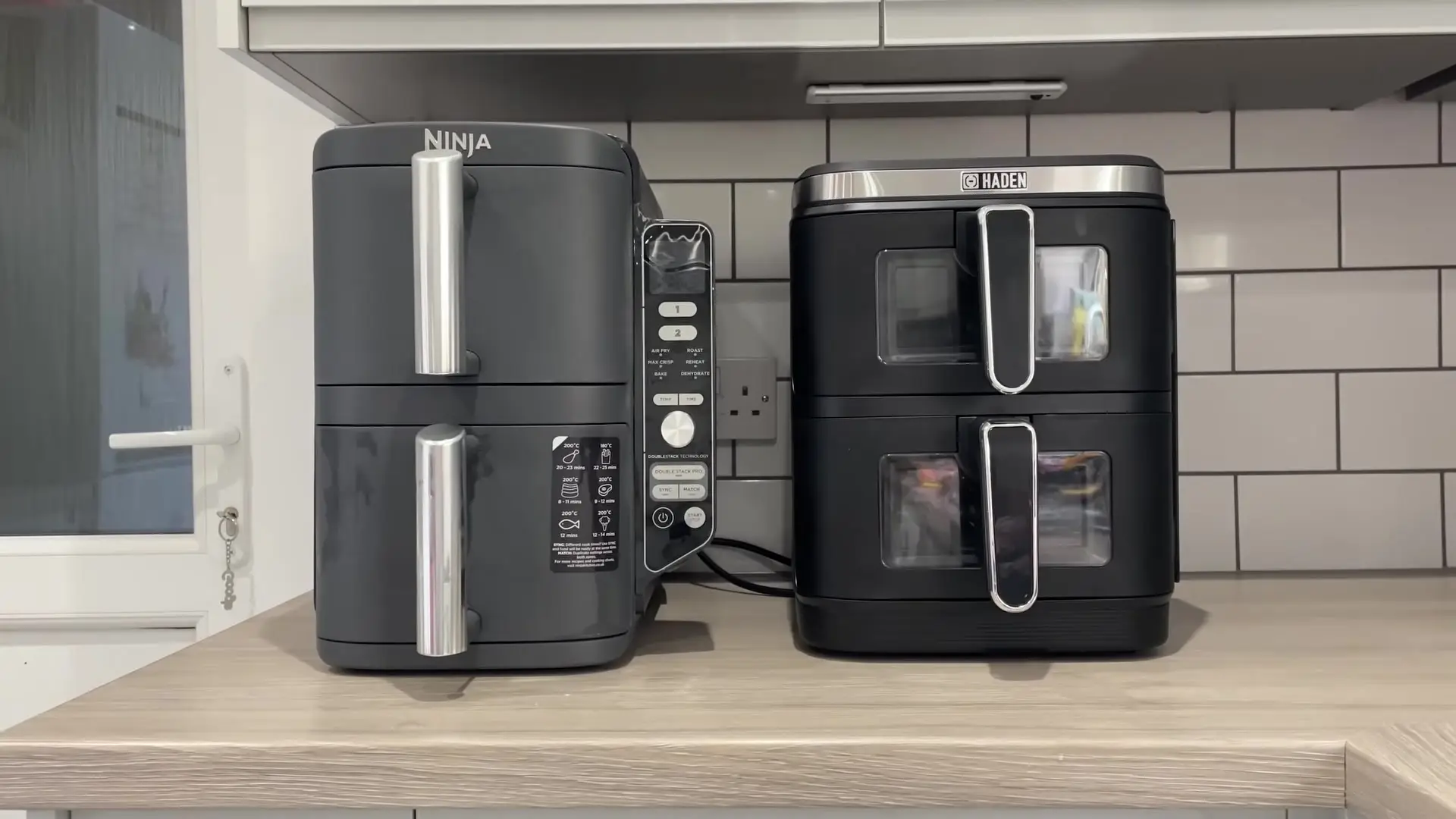
The first thing you notice about the Haden when you take it out of the box is just how large it is. It has an 11-litre capacity, making it the largest air fryer ever reviewed on this channel. Placed next to the Ninja Foodi Max and the Ninja Double Stack, both of which are 9.5 litres, the size difference is immediately obvious.
The Ninja Double Stack was built to fit the standard gap between worktops and kitchen cupboards. However, not everyone has a standard kitchen, and the Haden, being 2cm shorter, may actually be a better fit for some households.
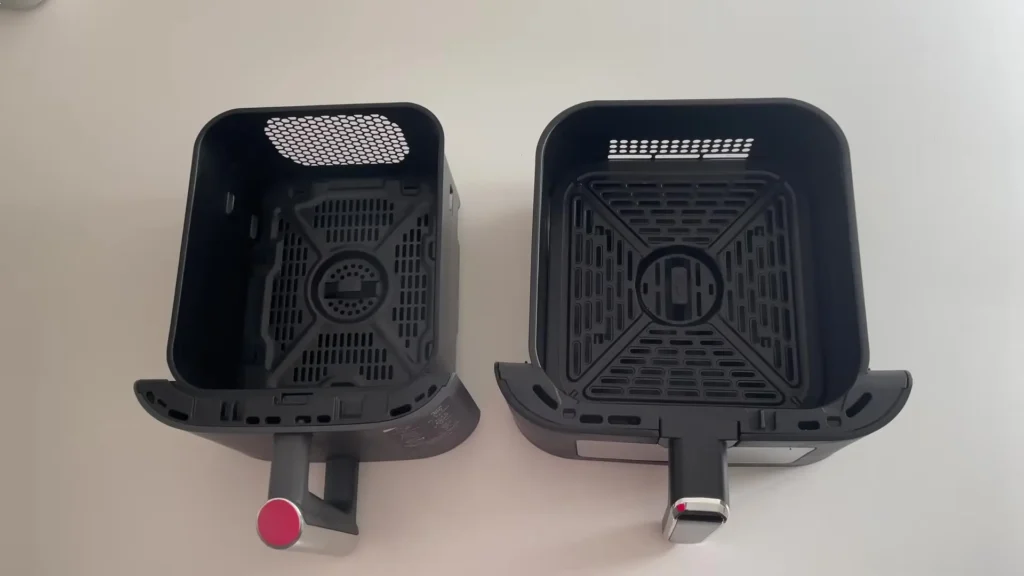
The drawers on these two air fryers are also very different in shape. The Haden drawer is nearly 2cm shorter than the Ninja and almost square. That larger surface area means it can fit a standard 7-inch cake tin that you would normally use in a conventional oven, and it is also better suited for pizzas.
Build Quality and Cleaning
The Ninja’s crisper plate and drawer are dishwasher safe. However, dishwashers are not mentioned anywhere in the Haden’s cleaning instructions, so it is safe to presume you cannot use them. Ninja’s drawers are made with a PTFE coating, and the crisper plates feature a non-stick aluminium surface with a nanoceramic coating.
When it comes to the Haden, there is no information available about what the non-stick coating actually is. Even after reaching out directly to the manufacturer, no reply was received. What was noticed during testing is that after only one or two uses, cooking residue was already starting to stick to the surface, which raises some concerns about long-term durability.
Both double stack models have vents at the back of the drawers. However, the Ninja’s crisper plate has two positions it can be placed in, and that higher cooking position, which the Haden lacks, is recommended for better crisping and a more even finish on food.
Cooking Zones, Heating Elements, and Interior Design
Both of these double stack air fryers have two independently controlled cooking zones, each completely self-contained with their own fans and heating elements. This is particularly useful if you have a family member who is vegetarian, as you can cook entirely different meals at the same time without any cross-contamination.
The heating elements on both models are positioned at the back rather than overhead, as you would typically see on a side-by-side drawer air fryer. This positioning is a compromise and will never be quite as effective as having the elements directly above the food, but these models have been built with a small footprint as their primary goal.
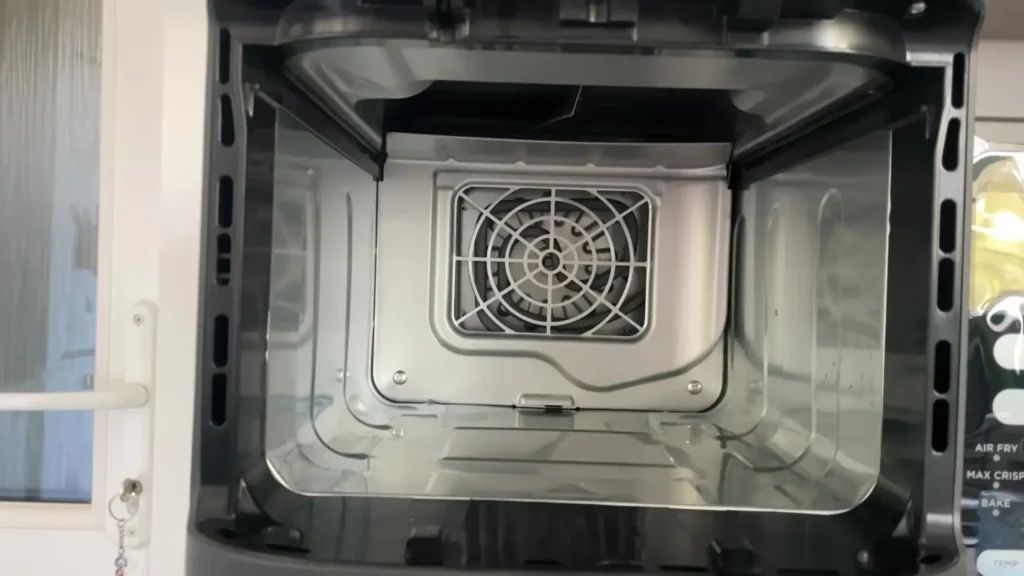
Inside both air fryers, there are some metal channels in the roof. It is not explained anywhere what these are for, but they likely serve a similar purpose to the embossing found on the bottom of Philips air fryer drawers, which is to help air circulate more effectively.
Because this version of the Haden Double Stack has windows in the drawers, it also includes a light in each compartment. However, there is no option to turn the light on or off. It simply stays on throughout the entire cooking cycle.
Accessories and Rack System
The Ninja comes with two racks included in the box and features a specific Double Stack Pro function that aids air circulation when cooking on two levels simultaneously. The Haden does not have this function and does not offer racks that fit its drawers, either included in the package or available to buy as accessories. Because it is a lesser-known brand, finding third-party manufacturers selling compatible racks will also be difficult.
Control Panels
Both double stack models have their control panels positioned on the right-hand side. Many users have complained that this feature on the Ninja wastes an important 5.5cm of worktop space when the appliance is not in use. One genuinely useful feature on the Haden is the ability to fold the control panel flat against the side of the air fryer when it is not in use, which is a practical space-saving touch.
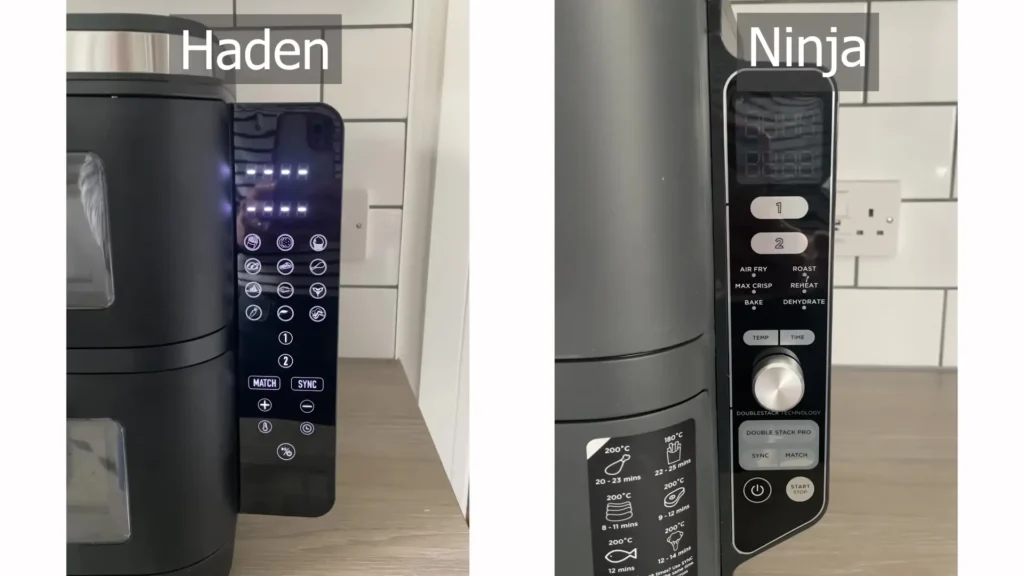
The downside to the Haden’s shiny touchscreen control panel is that it picks up fingerprints very easily. In common with many more budget-friendly air fryers produced in countries that read right to left, the plus and minus controls are reversed on this model.
The on/off and start button is also combined into one. With the Ninja, the one minor frustration is that the dial can be a little fiddly to use if the air fryer is positioned in a tight space hard up against a wall.
Also Read: Ninja Flexdrawer vs Cosori Twin Fry vs Duronic AF34 Air Fryers Comparion
Cooking Functions
Cooking options on the Ninja include the standard six functions also seen on the Foodi Max: air fry, max crisp, bake, roast, reheat, and dehydrate. These are settings rather than presets, and they offer three different fan speeds.
The Haden, on the other hand, has 12 presets, which are pre-programmed times and temperatures designed for different popular food types. Haden refers to these as AutoCook settings, and they cover French fries, biscuits (which likely means cookies), cake, chicken, steak, drumsticks, pizza, fish, sausages, vegetables, prawns, and chicken wings.
Both double stack models offer the option to duplicate settings from one drawer to the other at the touch of a button, and both allow you to sync the drawers so that foods with different cooking durations finish at the same time.
Power Consumption
When it comes to power consumption, all is not quite what it appears on the product description. The Haden has an impressive-sounding 2,800 watts compared to the Ninja’s 2,470 watts, so you might assume the Haden is the more powerful appliance. However, during a 10-minute energy test, the Haden actually used less power than both the Ninja Double Stack and the Ninja Foodi Max.
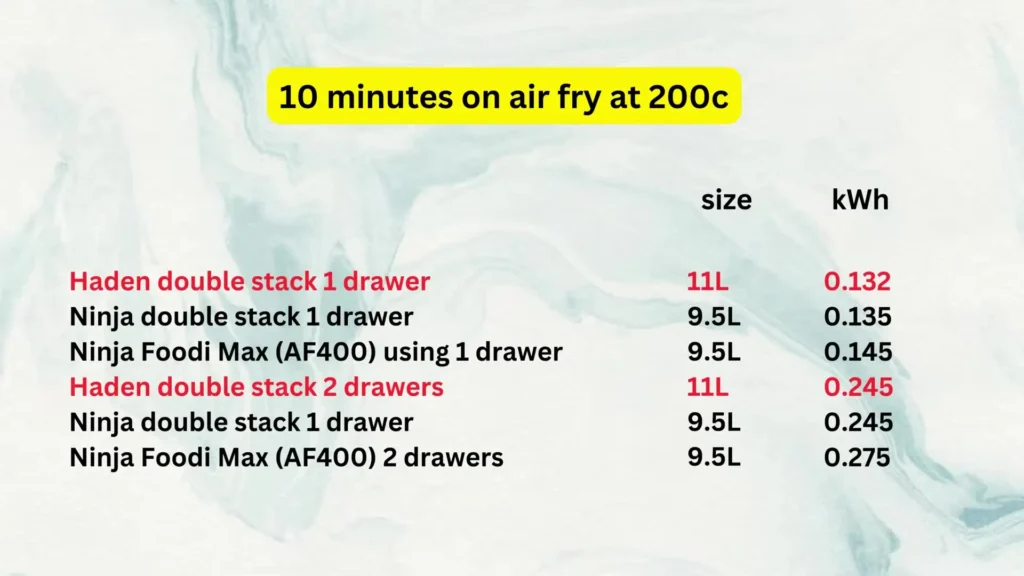
This brings up an important point about wattage ratings. When looking for a powerful appliance, it is very easy to focus on the big number and assume a higher wattage means more power. But time and again during testing, big numbers have not translated into real-world performance. The Haden is a clear example of this pattern.
Real-World Cooking Tests
It was not entirely surprising to discover that the Haden was using less power, because right from the start, everything cooked in it seemed to be taking longer than expected. Chips took twice as long as recommended on the packet. Mac and cheese, which normally takes 20 minutes straight from the freezer, took 35 minutes in the Haden.
A cake recipe that has been cooked many times in other air fryers, one intended for a conventional oven at 160 degrees for 20 to 25 minutes, was nowhere near done after 20 minutes in the Haden. Both halves of the cake had to go back in at 170 degrees for an additional 18 minutes, making the total cooking time nearly twice what it would take in a comparable air fryer.

Sausages and potatoes told a similar story. Even the Tfal Dual Drawer, which was considered slow during its own review, produced better results at the 15-minute mark than the Haden did. Chipolata sausages, which have a lot of surface area and should cook relatively quickly, took 30 minutes and came out unevenly browned.
Interestingly, it appears that Haden may already be aware of this issue. Looking at the instruction booklet, stickers have been placed over the recommended cooking timings for various foods, and when you hold the page up to the light, you can see that the timings underneath have actually been increased.
However, it was not all bad news. Cookies cooked on the cookie preset came out perfectly. The preset happened to use exactly the same time and temperature that you would normally bake cookies in a conventional oven, and the results were excellent.
A temperature test was also carried out to check whether the Haden was actually reaching its maximum temperature of 200 degrees Celsius. It did reach 200 degrees, but it took 8 minutes to get there, compared to approximately 3 minutes in the Ninja. The Haden’s temperature range sits between 60 and 200 degrees Celsius, while the Ninja ranges from 40 to 240 degrees.
The Ultimate Test
The definitive test for the Ninja Double Stack XL vs Haden Double Stack comparison was cooking a whole chicken in each air fryer at the same time. To make things fair, wireless temperature probes were used to monitor the internal temperature of both chickens and determine exactly when each one reached the safe internal temperature of 74 degrees Celsius.
Since the Ninja was expected to be faster, it was given the slight handicap of the marginally larger chicken. Both chickens registered the same temperature on their probes when they went into the air fryers. Early on, the Ninja took the lead and the gap between the two probe readings kept growing.
The Ninja reached 74 degrees Celsius on the slightly larger chicken after 50 minutes. The Haden took an additional 22 minutes, reaching the target temperature after 1 hour and 12 minutes.
Comparison Table: Ninja Double Stack XL vs Haden Double Stack
| Feature | Ninja Double Stack XL | Haden Double Stack |
|---|---|---|
| Price (RRP) | £269.99 | £149 (with windows) |
| Capacity | 9.5 Litres | 11 Litres |
| Height | Standard worktop height | 2cm shorter than Ninja |
| Cooking Zones | 2 independent zones | 2 independent zones |
| Heating Element Position | Rear | Rear |
| Wattage | 2,470W | 2,800W |
| Actual Energy Use | Higher | Lower (despite higher wattage) |
| Temperature Range | 40 to 240 degrees C | 60 to 200 degrees C |
| Time to Reach Max Temp | Around 3 minutes | Around 8 minutes |
| Cooking Functions | 6 settings with 3 fan speeds | 12 AutoCook presets |
| Racks Included | Yes (2 racks) | No |
| Double Stack Pro Function | Yes | No |
| Sync Finish Feature | Yes | Yes |
| Duplicate Settings Feature | Yes | Yes |
| Dishwasher Safe Drawers | Yes | Not confirmed |
| Non-Stick Coating Info | PTFE and nanoceramic | Unknown |
| Control Panel | Right side dial | Right side foldable touchscreen |
| Interior Light | No | Yes (always on) |
| Window in Drawer | No | Yes (on this version) |
| Whole Chicken Cook Time | 50 minutes | 1 hour 12 minutes |
| Worktop Space When Not in Use | Takes up 5.5cm extra | Panel folds flat |
| Brand Origin | US brand | British brand (since 1958) |
Which Double Stack Air Fryer Is Worth Your Money?
It is undeniable that the Haden does not match the Ninja for cooking speed. The performance gap is significant and consistent across every cooking test carried out. However, it is not completely without merit either. If you are working in a small space without a conventional oven and you are comfortable with longer cooking times, the Haden may still work for you, particularly given its lower price point and its impressive 11-litre capacity.
That said, if cooking speed, build quality, and overall performance matter to you, the Ninja Double Stack XL is the clear winner. You are paying more, but you are getting a faster, more consistent, and better-built appliance in return.
Read More: Ninja Speedi Review